Sunday, December 12, 2010

homely tubes

Pneumatic tube systems are used in hospitals, supermarkets, banks and pharmacies. But what about our own homes?


A UK-based project called Foodtubes, which promises to revolutionalise food transportation via pneumatic/vacuum technology, has recently led to all sorts of incredulous outcries and postulations by techie and environmental bloggers embracing and ridiculing the idea. Someone who has commented on the grist blog post about this issue argues that it is a waste to use Foodtube technology at the organisational level, but rather it should be taken into our own homes:
"I don't know about replacing deliveries to stores... trucks are awfully efficient for that! Make them electric, and they'd be hard to beat. On the other hand, pneumatic tubes could provide efficient delivery to individual homes, eliminating the need for people to go to the store. With modern barcode or RFID systems, the packages could be routed to the correct house easily enough. Some things might not do too well - I wouldn't want to cram a 20-pound watermelon into a 6-inch tube - but for most staples it would work quite well"
It isn't the first time that pneumatic tube technology has been considered for home usage. Remember that great Heineken ad from a few months ago? There is also the home elevator, as well as centralised home vacuum cleaning units. My dad remembers one of these units being installed in his parents' new home in the 1980s. It seems that home-based pneumatic tube technology is either something from the past, or the projected Jetsonian future, but is it for us right now?

Image courtesy of fabulousfairy.

Sunday, December 5, 2010

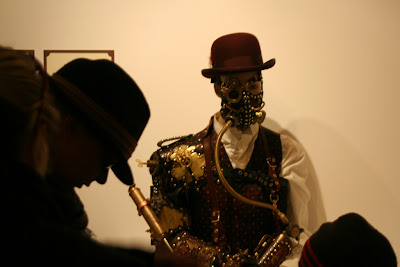
steampunky tubes

I have had another hiatus away from the blog, this time due to a relocation to Maastricht, to work on an exciting new research project at the Virtual Knowledge Studio. I'll write more about that another time, but this snowy Sunday afternoon, I thought I would write about something that has been on my mind for sometime: steampunk!

Older pneumatic tube systems have long been associated with steampunk culture - all those knobs and brass and gorgeous ornate, futuristic detailing:


I have always liked this aesthetic dimension to pneumatic tube systems, an aesthetic that was first introduced to me by my sister's partner Jarek. What has prompted me to write about it today are two publications: the most recent edition of Neo-Victorian Studies, completely devoted to the topic; and a series of blogposts by lord_k on Dieselpunks, here, here and here. The latter is a well-researched essay in three parts, filled with photos and the mention of a number of books and films where pneumatic tubes are actors (many added to my reading list).

Contemporary hospital pneumatic tube systems have retained little of the steampunk vibe, with all of their plastic and duct-tape-able parts. But the fact that these systems are now computerised does not necessarily prevent a few steampunk elements being introduced (see this steampunk workshop site for a fantastic post about how to build a steampunk computer).


For those interested in medical museums, Thomas
Söderqvist has written about steampunk medical objects on his blog Biomedicine on Display, and there is a current exhibition at the The Charles River Museum of Industry and Innovation and past exhibition at the Museum of the History of Science worth checking out.

Images from wikimedia commons, flikr (falling_angel) and steampunk workshop.

Friday, November 5, 2010

pneumatic tube cartoons

There is a great collection of videos on YouTube put out by pneumatic tube company Telepost (see this previous post for a YouTube video by Swisslog). The cartoons are cute, the music catchy and they do a great job of illustrating the work of pneumatic tubes (their human-like attributes being key to actor network ideas about the social life of non-human entities).


This video is about hospitals but there are more set in supermarkets and other places where the company installs pneumatic tube systems.


Wednesday, November 3, 2010

natural history museums and boundary objects

Recently I have been re-reading work by the sociologist of science, Susan Leigh Star, for a paper I am writing with my supervisor. Sadly Susan Leigh Star died this year, unexpectedly, leaving a great sense of loss in her personal and professional worlds.

One of my favourite papers by Leigh Star (and James Griesemer) was 'Institutional ecology, 'translations' and boundary objects: amateurs and professionals in Berkeley's Museum of Vertebrate Zoology, 1907 - 1939' (Social Studies of Science 19(3): 387 - 420), which discusses the ways in which members of different social worlds coordinated their efforts in building the museum. Leigh Star and Griesemer's ethnographic study was ecological, in the sense that it included the perspectives of administrators, amateur collectors, professional trappers, farmers who served as occasional fieldworkers and zoologists. In this paper, the authors introduced the concept of the 'boundary object', which they explained as that which facilitates common understandings between multiple social worlds. It is a concept which has been used widely in the discipline of STS, and other areas of research, ever since.


I could not help but also think of this study when visiting the Tasmanian Museum and Art Gallery in Hobart with my mother (see her own blog post about the visit here Home Tweet Home: Museum Visit). At the museum we did fieldstudies: I took photos of the zoology exhibits and mum sketched some beetles and butterflies for inspiration for her ceramics. Whilst we were photographing and sketching, we had a number of conversations - one with a visitor and another with a gallery guide – about the animals that we were picturing/drawing, and other tales of flora and fauna. The taxidermy was a boundary object in the very similar, almost literal, sense used by Leigh Star and James Griesemer, as something which facilitated an interaction between our different worlds of experience and interest.

This led me to wonder whether pneumatic tube systems are boundary objects? I am not sure if anyone has any thoughts on that? In many ways, the technology serves to facilitate multiple transactions between different worlds. For example, in hospitals, pneumatic tubes are considered, and used, quite differently by engineers, pathologists and nurses. But I wonder whether pneumatic tube systems are really 'plastic' in their adaption to local needs, or are they more structured?
Photos are my own.

Wednesday, October 27, 2010

zorba and duct tape

In Stoic philosophy, pneuma is the active and creative presence in matter and exists in inanimate objects - including duct tape?

Thanks for the great guest photo Andy, of yet another use of duct tape.

Tuesday, October 26, 2010

one of the earliest pneumatic tube systems in a hospital?

I recently came across an article called Pneumatic Tube Systems, in a 1966 issue of the British Medical Journal (1st January 1966, p49 - 50). Could it be mentioning one of the earliest pneumatic tube system infrastructures in a hospital?

SIR,- The use of pneumatic-tube transmission systems in general and in hospitals in particular is by no means new. Some of the earlier hospital systems received very adverse criticism, and this undoubtedly delayed progress of this efficient and speedy service so far as hospitals were concerned.

Recently a two-way point-to-point tube system by Dialled Despatches Ltd., Gosport, was installed in this department for the specific purpose of conveying exposed but undeveloped x-ray films from an x-ray room at a return clinic area to a developing room fitted with an automatic processing unit some 100 ft (30 meters) away at the other end of a long and relatively narrow building. Dry developed films are returned to the clinic in an average time of nine minutes. I believe that this may be the first tube system to be so used, and it has been found to be very effective in practice. The exposed film is removed from its cassette in a dark cubicle some 3 ft. square (0.8 sq. metre), marked with the patient's name, date, etc., rolled in its original packing paper in order to avoid unnecessary handling and static marks, and placed in the cylindrical aluminium carrier, which is then put into the sending tube. Two or even three films, if necessary, can be put into a carrier at any one time. The carriers are long enough to take the largest x-ray films, and are, of course, light-tight. The receiving end of the return tube has been separated from the sending tube, and is situated outside the dark cubicle so that the developed films can be delivered to the clinic without interrupting the radiographer. The cost of installation of this system was not greater than the cost of constructing and equipping a small but conventional darkroom, for which, in any case, there was insufficient space available in the area, and the need for additional dark-room technical assistance was avoided.

Although this simple point-to-point system was installed for one particular purpose, trials using special inserts in the carriers have shown that laboratory specimens and blood samples can be safely transmitted without damage or lysis. These experiments suggest that larger installations, either fully or semi-automatic, and relying on the operation of recently developed and much more reliable proximity switches, should play a major role in future hospital design and equipment. - I am, etc.,

A.M.Murray, Casualty Department, Royal Infirmary,
Glasgow C.4.

The article certainly seems to be detailing the very early use of pneumatic networks for transporting films and pathology samples. This x-ray system is undoubtedly a precursor to modern day electronic platforms, such as PACS, designed for the efficient transmission of radiological images, "without interrupting the radiographer".

correspondances pneumatiques

Some pneumatic post arrived in the mail last week, from my sister's fiancé, Jarek ...

... filled with wonderful photos from the Museé de la Post in Paris:

I love post with personality!

Thanks Jarek (and Dad for scanning the images).

Tuesday, October 19, 2010

call for papers 2

These recent calls for papers tie in art, medicine and ethnography ...

AAH (The Association of Art Historians) Annual Conference 2011
31 March – 2 April, University of Warwick
Medical Media: The Aesthetic Language of Medical ‘Evidence’

Visual culture plays no small part in the field of medicine, historically and currently. In teaching and practice, the field has been and continues to be inundated with images: X-rays, before-and-after photographs, case records and illustrations, digital scans, recorded demonstrations, etc. At once document and representation, the image utilised for medical aims occupies a curious place, particularly when it is clear that the methods of its production have been mediated by the physician, the patient, and/or the artist-producer to emphasise its value as ‘evidence.’ The photograph is the most obvious, and yet far from sole, medium of medical imagery: three-dimensional models of varying media, posters, print media, and film have all played the role of ‘medical documentation.’ This session seeks to complicate the relationship between art and medicine as one in which images are passively illustrative of medical ideas or mechanisms, as visual simplifications of theories and practices. So too does it wish to investigate how medical ideas or devices affect perceptions and productions of art.The following questions are therefore posed: how has art – its grammar, forms, varying media – articulated or represented medical concepts, discoveries, inventions or models of perception?

How has medicine been understood through its visual culture? And how have medical explanations and new technologies informed aesthetic models and vocabularies? In other words, do Art and Medicine speak the same language? Diverse papers are welcomed from art and medical historians on any period and geographical location that explore new directions in the interconnected histories of these disciplines. Session Convenor:Tania Woloshyn, McGill University. woloshyn.tania@googlemail.com


Artful Encounters: on ethnography, art and conservation
Seminar November 18 & 19, 2010, Maastricht

Although highly critical of its colonialist connotations, many artists today employ methods that traditionally belong to the academic discipline of anthropology. They claim to use ethnography as an integral component of their artistic practice (Foster, 1999; Desai, 2002). Those studying the arts (academic disciplines such as art history, cultural studies, etc., as well as more “applied” disciplines such as conservation) may use these very same ethnographic methods to understand and deal with art worlds (Morphy & Perkins, 2006; Van Saaze, 2009). Understanding contemporary art today therefore increasingly asks for an approach that is sensitive to local and changeable meanings, to process and the ephemeral qualities of works-in-progress, and to the ways in which the public sphere can become an arena for artistic investigation. This combined seminar stages a series of encounters between ethnographic artists, ethnographers of art, and conservation ethnographers within this methodological hall of mirrors. Of special interest is the process of documentation within ethnographies. How do ethnographers hold what they find? Methodology-handbooks as well as reflections about fieldwork discuss exhaustively the art and pitfalls of note-taking, interpretation, categorization, narration, and writing. Yet, the variety of means of documentation is much greater and different styles of documentation allow for different effects.


Artful Encounters wants to examine the interesting overlaps between academic ethnography on the one hand and artistic practice in its broadest sense – both its process and its conservation – on the other hand. The seminar has three aims: (1) to improve ethnographic research by sharing research experiences; (2) to explore overlaps and differences in ethnographic methods between two different but fundamentally connected positions: the artist as ethnographer and the ethnographer as artist; and (3) to investigate what the ethnographic research tradition could contribute to the field of artistic research.Through open discussion, paper presentations, workshops and special assignments participants are invited to
contribute to the revitalization of an old tradition by setting a new agenda in artistic practice and arts research.