Wednesday, May 2, 2012

pencils and post


In her essay, My Life in Pencils, Mary Norris describes her now obsolete job at The New Yorker, called collating, where she had to copy legibly all changes on a piece of writing (from editor, author, fact checker and proof reader) onto a clean proof page, which was then put into a cannister and sent, via pneumatic tube, to a higher floor where the changes were transmitted, by fax, to a printer in Chicago.

This leads her to ponder the pencil. It is a lovely little essay, in which the writer describes moving from a soft No. 1 pencil to a harder No. 2 pencil as feeling like she had a hangover. A party she attends is hosted by a sixth-generation pencil-maker, dressed "in shades of pencil lead". Not only does this piece refer to yet another use of the wonderful pneumatic tube, but it also lovingly celebrates another technology which is largely taken for granted.

Wednesday, April 18, 2012

crash course in pneumatic tubes

In New Dehli or Ottawa, or at least nearby?

Here are a couple of courses which might take your fancy:


The International Institute of Healthcare and Medical Technologies is offering a three day crash course in August about pneumatic tubes.

Who should attend? Hospital administrators, hospital engineers, biomedical students, hospital consultants, hospital architects, and pneumatic tube ethnographers perhaps? Visit http://www.iihmt.org/ for more details or email info@iihmt.org.


The Canada Science and Technology Museum is offering a five day course on reading aftifacts also in August, where participants get to explore using artifacts as resources for research and teaching, explore material culture methodologies and learn conservation, cataloguing and collection techniques.

Who should attend? Graduate students, post-docs, faculty interested in teaching history through artifacts and scholars seeking to expand their research methods. Registration closes June 15th. For further information contact sbabaian@technomuses.ca.

Image my own, from the Post Museum in Paris.

Saturday, April 14, 2012

an extinct tube station called post office

For some years now, every time I have asked for stamps for my post, I have been given a print-out label. I know this is easy and efficient and that the postmistresses and masters have long lunchtime queues and other important requests like phone bill payments to deal with, but really, has the perforated, lick-able and often (although less and less these days) beautiful stamp really disappeared so much from our consciousness that even those who work in postoffices can't recognise what it is?


In my local 'postoffice' in Exeter - a completely unromantic place in a characterless mall, akin to the shopping complex-style cinemas we are now forced to put up with - there is one window where you can buy 'interesting stamps';that is stamps which are not just multicoloured variations of Elizabeth's profile (as iconic as that is!). This is of course one step up from the Netherlands, where the only option is standard issue local and international stamps sold in newsagents, but still, the stamp buying experience is somewhat diminished when you have to wait for the right window to call your number. I know that there are other stamp lovers in Exeter though, as the post office's fantastically foxy Roald Dahl stamp stash is now depleted, with only the dreary prospect of Olympic stamps ahead.

The relegation of interesting stamps to the corners of postoffices and their disappearance from our mail is part and parcel of a larger decline in postal practices. The Guardian ran a story last week farewelling the great age of the post office, a great age that had already started to disappear early last century when post offices were demolished in London and tube station names changed from Post Office to St Paul's. More recently postal services the world over are losing money, lots of money. "Weightless electronic words" (Meek 2011) have proved too powerful a competitor to the written word. In 2005 the letter market went into absolute decline, falling ever since and by 2015 it is predicted that letter volumes will decline by another 25 - 40 percent.

A rather grim picture of Dutch and English postal networks is painted in an excellent essay by James Meek in the London Review of Books last year. Meek follows letters ethnographically, meeting the Dutch postal workers who sort out crates of mail (catalogues and magazines) in their flats and the bureaucrats reorganising Royal Mail services. Before Meek started the essay he had planned to set up the interviews by post, but he didn't think about it very long. Instead he phoned, emailed, texted, skyped, chattered and googled.

So here is yet another rant to add to the many moans about the loss of postal magic from our lives. This is more than nostalgia for the past, but rather sadness that slow, time-consuming, thoughtful practices such as correspondence by post are disappearing in contemporary society, as are the infrastructures which support them. So I am going to sign off now, go and make myself a cup of tea, and write a letter.

For other blogs celebrating post see for example: letters of note (thanks Joeri) letterheady and everyday should be a red letter day.

Photo my own, taken during conference trip in Oxford, 2011.

Saturday, April 7, 2012

hospitals of music and flowers

A beautiful series of photos in Colossal has been making the blog rounds recently, of Anna Schuleit's installation Bloom. This moving work involved the careful placement of twenty-eight thousand pots of flowers in various wards of a closed mental health hospital in New England, USA.


Usually photos of closed hospitals highlight decay, disuse and disrepair. Schuleit's installation on the other hand tells a somewhat more poignant story. Asked to create a sit-specific work for the closed hospital, which would be open to the public for four days, she chose to inundate the space with flowers, to reflect on the sad absence of flowers in psychiatric settings. After the exhibition closed, the flowers were then delivered to nearby shelters, half-way houses and psychiatric hospitals. This is not the first time that the artist has produced a site-specific work in a hospital. In 2000 she created a sound installation in another disused New England hospital called Habeas Corpus, where visitors listened to a recording of Bach's Magnificat pouring out of the shattered window panes.

Image from trendhunter and thanks to Daniele for sending me this link.

Tuesday, March 27, 2012

freight tubes of the future

Thanks to Andy for sending me this picture from Retronaut, of the 1920s city of the future, complete with freight tubes:


Wednesday, March 21, 2012

as winter slides into spring

It seems only fitting to mark the changes of the seasons with some beautiful microscopic slides. Two years ago I was fascinated by the nonist's exquisite microscopic specimens. Now I have discovered Wilson Bentley's 1880s microscope-photographs of the ephemeral, melting, delicate snowflake:


Images from Wikimedia Commons.

Tuesday, March 13, 2012

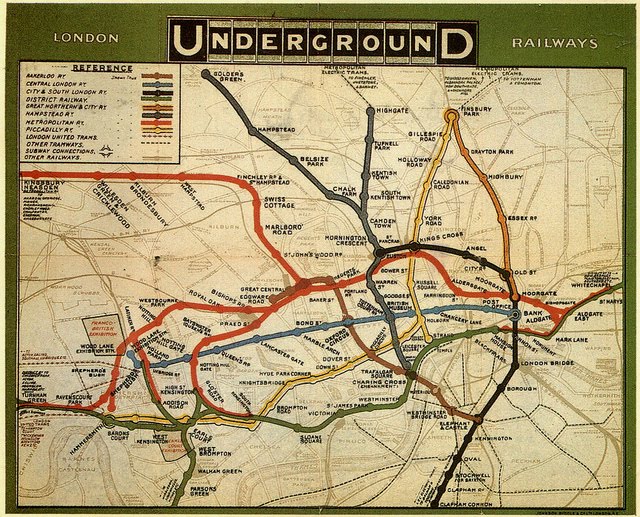
london tubes

I am going to London in April. After four months now of living in England I am itching to visit the nation's capital, my mouth watering already for London restaurant meals and the coffee I hear some Melbourne baristas are brewing in Antipodean cafes, as well as the galleries, the museums etc etc. Oh yes, and the excellent conference I am attending on genetics!

Think London and you think underground. Or 'the tube'. The iconically represented networked system of transportation is now synonymous with the city. In Flesh and Stone, Richard Sennett describes the London Underground as both an artery and a vein, transforming the social condition of Londoners by allowing them to live further outside the city centre, facilitating mass consumption, and supposedly creating a more "mixed" city.

It is because of the human blood like flows of people however that Sennett proposes that the city was not mixed but rather that human contact between the classes was limited. During the day, the arteries took people below ground into the heart of the city, creating density by daylight, while at night the subterranean channels emptied the masses from the centre, leaving a sparsely populated city.

Tubes and vessels, pipes and lungs: the circulatory system and respiratory system are often used to describe urban flows of transportation, communication and other forms of movement. What does it mean to use these medical metaphors? Particularly in contexts such as hospitals, if we want to describe pneumatic tube systems in this way, where vessles, arterioles, air sacs and tracheas take on a particular clinical relevance? The metaphors we use tell us something about norms, attitudes, values and so forth, and this is something I have previously explored, and will continue to explore, when thinking about pneumatic tubes.

Image from Roger Wollstadt's Flikr photostream.