I attended a medical sociology conference in Belfast recently, at the beautiful Queen's University. I wasn't expecting to talk about pneumatic tubes here (although Belfast is famous for a pneumatic invention of another kind), but rather about the healthcare professions.
One morning as I was preparing for the conference, I was listening to the BBC news and pneumatic tubes appeared on the hotel TV screen. A new hospital was opening its doors in Wolf Lough, near Enniskillen. The first new hospital to be built in Northern Ireland in over a decade, a sign of further rejuvenation of this previously troubled area.
Amongst the other "state to the art technology" being showcased was a "vacuum transfer system" to "allow for drugs, products and lab reports to be transferred around the hospital without being totally reliant on porters. It will also help speed up the discharge of patients who are often delayed awaiting prescriptions".
The hospital is said to epitomise "everything that is modern in a 21st century health service". There are no wards, just single rooms, each complete with flatscreen TVs and floor to ceiling windows said to promote therapeutic healing. The Royal College of Nursing is worried that there aren't enough nurses for this new layout.
Not enough nurses, too many porters. Although more nurses and porters are being hired for the hospital, these new hospital designs are shifting divisions of labour on the wards. What does it mean that the vacuum transfer system will make the hospital less reliant on porters? How will the work load of nurses change with these single bed rooms? Are architects now becoming a new healing profession, with their therapeutic window designs?
Pneumatic tube technologies and other aspects of contemporary hospital design raise these kinds of questions about how healthcare professions are continually evolving, and I had plenty to think about while joining the discussions at Queen's.
Monday, July 16, 2012
Wednesday, July 11, 2012
going underground
Travel underground to a conference that examines the subterranean nervous system of London: the tube.
Deadline in two days! 13th July 2012. See CfP below:
Going Underground: Travel Beneath the Metropolis 1863-2013
A Conference to Mark the 150th Anniversary of the London Underground
10 January 2013 will mark the 150th Anniversary of the public opening of the Metropolitan Railway in London. It was the world’s first urban rapid transport system to run partly in subterranean sections. As the precursor of today’s London Underground, it was not only a pioneer of technological and engineering advances, but also instigated new spatial, political, cultural and social realms that are now considered to be synonymous with London and modern urban experiences across the globe.
The Centre for Metropolitan History, Institute of Historical Research, is marking the anniversary by organising a two-day conference dedicated to the history and use of the London Underground.
Taking the construction and opening of the Metropolitan Railway as a departure point, this conference seeks to explore the past, present and future of the London Underground from a variety of perspectives that investigate its histories, geographies, cultures, politics and social characteristics.
The conference organisers invite proposals for papers of 15-20 minutes in length. Please visit the conference website for further details: http://www.history.ac.uk/events/london-underground.
10 January 2013 will mark the 150th Anniversary of the public opening of the Metropolitan Railway in London. It was the world’s first urban rapid transport system to run partly in subterranean sections. As the precursor of today’s London Underground, it was not only a pioneer of technological and engineering advances, but also instigated new spatial, political, cultural and social realms that are now considered to be synonymous with London and modern urban experiences across the globe.
The Centre for Metropolitan History, Institute of Historical Research, is marking the anniversary by organising a two-day conference dedicated to the history and use of the London Underground.
Taking the construction and opening of the Metropolitan Railway as a departure point, this conference seeks to explore the past, present and future of the London Underground from a variety of perspectives that investigate its histories, geographies, cultures, politics and social characteristics.
The conference organisers invite proposals for papers of 15-20 minutes in length. Please visit the conference website for further details: http://www.history.ac.uk/events/london-underground.
Tuesday, July 10, 2012
tubes: behind the scenes
Referencing the infamous Ted Stevens comment about the internet, Andrew Blum has written a book simply titled Tubes.
The book may be of interest to some readers of this blog, not only for the title, but also because, according to the New York Times book review, it examines the materiality of technology. Here is a section from the book:
I have confirmed with my own eyes that the Internet is many things, in many places. But one thing it most certainly is, nearly everywhere, is, in fact, a series of tubes. There are tubes beneath the ocean that connect London and New York. Tubes that connect Google and Facebook. There are buildings filled with tubes, and hundreds of thousands of miles of roads and railroad tracks, beside which lie buried tubes. Everything you do online travels through a tube.
I haven't read the book but am intrigued, not only by Blum's pursuit of fibre cables, but also by another section of the book quoted in the book review, where Blum learns that the Internet in has a smell, "one he describes as 'an odd but distinctive mix of industrial strength air-conditioners and the ozone released by capacitors'". This reminds me of the smell of engine rooms I have visited to see the hub of pneumatic tube activity. So often the sensory dimensions of the internet are forgotten in the focus on the ephemeral and virtual, but this technology too, so this book promises to tell us, also has multisensory, material dimensions.
Thanks Andy for the link.
Monday, June 4, 2012
ghastly remnants of a dead medium?
Are pneumatic tubes dead? Or to use a Princess Bride phrase, "mostly dead"?
It seems so, according to the entry on pneumatic tubes in the wiki Dead Media Archive, although the wiki contributors acknowledge that there are "ghastly remnants" of the dead medium, including a limited rebirth in a hospital (sounds like something from Riget).
The Dead Media Archive is described as concerning "historical research into forgotten, obsolete, neglected or otherwise dead media technologies", qualities which do not seem to describe the pneumatic tube systems currently alive and well in institutions (and some homes!) all around the world.
Despite its eulogy style rendering of pneumatic tube systems, the dossier is very good, covering the origins of pneumatics in Ancient Greece, through to the hundreds of patents submitted for tube technology in the late 19th Century. Authors/editors ponder the difference between the telegraph and pneumatics, writing that "unlike the telegraph, which digitizes messages, the pneumatic letter retains analog meaning, which could range from your handwriting to the type of stationary you use".
For those interested, there is a fabulous list of resources at the end of the article too, with some important Scientific American papers, including one from 1873 entitled “Novel Mode of Locating Obstructions in Pneumatic Tubes”, which describes a method of isolating pneumatic tube obstructions utilising sound waves.
There are also great dossiers on other dead media, including those which I remember from childhood (paperdolls, mixed tapes and walkmans), from my university days (microfilm and credit card imprinters), to those which still seem to be hiding in my parents' cupboards (phonebooks). And there is one article about a dead media which I wish wasn't so dead - shorthand - which I think would be wonderful to know as an ethnographer!
See the full list of Dead Media Archive dossiers here.
Image from Dead Media Archive of Albert Brisbane's pneumatic tube patent. Brisbane is often credited for 'inventing' the pneumatic tube, although its origins are reported in the dossier as a "hodge-podge" of previous patents and improvements.
It seems so, according to the entry on pneumatic tubes in the wiki Dead Media Archive, although the wiki contributors acknowledge that there are "ghastly remnants" of the dead medium, including a limited rebirth in a hospital (sounds like something from Riget).
The Dead Media Archive is described as concerning "historical research into forgotten, obsolete, neglected or otherwise dead media technologies", qualities which do not seem to describe the pneumatic tube systems currently alive and well in institutions (and some homes!) all around the world.
Despite its eulogy style rendering of pneumatic tube systems, the dossier is very good, covering the origins of pneumatics in Ancient Greece, through to the hundreds of patents submitted for tube technology in the late 19th Century. Authors/editors ponder the difference between the telegraph and pneumatics, writing that "unlike the telegraph, which digitizes messages, the pneumatic letter retains analog meaning, which could range from your handwriting to the type of stationary you use".
For those interested, there is a fabulous list of resources at the end of the article too, with some important Scientific American papers, including one from 1873 entitled “Novel Mode of Locating Obstructions in Pneumatic Tubes”, which describes a method of isolating pneumatic tube obstructions utilising sound waves.
There are also great dossiers on other dead media, including those which I remember from childhood (paperdolls, mixed tapes and walkmans), from my university days (microfilm and credit card imprinters), to those which still seem to be hiding in my parents' cupboards (phonebooks). And there is one article about a dead media which I wish wasn't so dead - shorthand - which I think would be wonderful to know as an ethnographer!
See the full list of Dead Media Archive dossiers here.
Image from Dead Media Archive of Albert Brisbane's pneumatic tube patent. Brisbane is often credited for 'inventing' the pneumatic tube, although its origins are reported in the dossier as a "hodge-podge" of previous patents and improvements.
Thursday, May 31, 2012
le bruit de choc
Paris in the 1890s, and a tubiste working in the Poste Pneumatique pulls a lever, cranks a steel door, exchanges cylinders and closes the door again. Sweat forms on his brow as he turns the wheel to create a vacuum and apply compressed air. He pauses to ring the bell so the next station knows of the coming delivery. A tubiste down the line rings his bell when he hears le bruit de choc as the tube arrives at his station.
This section of text, adapted from Molly Wright Steenson's Cabinet article, is filled with sound. The soundscapes of these brass-age pneumatic systems evoke the work involved in sending pneumatic missives underneath the city. These historic sonic delights are however considered pollution in many modern day hospitals, with an increasing call to 'turn the sound down' in clinical work spaces.
Swisslog have responded to this drive with their patent-pending Whisper Receiving System, which minimises noise associated with pneumatic transportation. Recently installed in the positively named Le Bonheur Hospital in America, the system is said to enable employees to concentrate better on the patient care requirements of the hospital. I wonder how the tubistes were ever able to get their work done with all of that cranking, clanging and bell ringing!
Image from Scott Kostolni's Flikrstream.
This section of text, adapted from Molly Wright Steenson's Cabinet article, is filled with sound. The soundscapes of these brass-age pneumatic systems evoke the work involved in sending pneumatic missives underneath the city. These historic sonic delights are however considered pollution in many modern day hospitals, with an increasing call to 'turn the sound down' in clinical work spaces.
Swisslog have responded to this drive with their patent-pending Whisper Receiving System, which minimises noise associated with pneumatic transportation. Recently installed in the positively named Le Bonheur Hospital in America, the system is said to enable employees to concentrate better on the patient care requirements of the hospital. I wonder how the tubistes were ever able to get their work done with all of that cranking, clanging and bell ringing!
Image from Scott Kostolni's Flikrstream.
Sunday, May 27, 2012
winding sentences, text and tubes
Of a time when sentences where long, space mattered in newspapers, and pneumatic tubes ran under the city streets ...
From The New York Times, September 30, 1892.
Sunday, May 20, 2012
DIY pneumatic tube system
Last year I reported on some evidence of vacuumpunk, as video bloggers document their DIY pneumatic tube systems. Looks like its a movement!
This and other videos can be found here, on the Hallo Spencer Fanblog.
Wednesday, May 16, 2012
embroidering anthropology
What is not to love about the gorgeous embroidered typography of this month's edition of the new online anthropology journal, Anthropology of This Century:
It is so nice when academia pays some attention to aesthetics.
Wednesday, May 9, 2012
pneumatic tubes in literature 4
Two fantastic paragraphs from
Slaughterhouse Five (p7) about the connections made between institutions, by the
brass and velvet pneumatic tubes, sent to me by my brother-in-law Andy:
While I was studying to be an anthropologist, I was also working as a police reporter for the famous Chicago City News Bureau for twenty-eight dollars a well. One time they switched me from the night shift to the day shift, so I worked sixteen hours straight. We were supported by all the newspapers in town, and the AP and the UP and all that. And we would cover the courts and the police stations and the Fire Department and the Coast Guard out on Lake Michigan and all that. We were connected to the institutions that supported us by means of pneumatic tubes which ran under the streets of Chicago.
Reporters would telephone in stories to writers wearing headphones, and the writers would stencil the stories on mimeograph sheets. The stories were mimeographed and stuffed into the brass and velvet cartridges which the pneumatic tubes ate. The very toughest reporters and writers were women who had taken over the jobs of men who had gone to war.
For those
interested in learning more about the Chicago Postal Pneumatic Tube Company, you may enjoy this thread on the Forgotten Chicago Forum, about the mysterious manhole covers in the city.
Image of the Chicago Postal Pneumatic Tube Company from the University of Illinois Library.
Saturday, May 5, 2012
poetic medic stamps
The H-Net listserv recently posted the news of a William Carlos Williams commemorative stamp, and as both an important poet and doctor, I thought this deserved a mention here too. William Carlos Williams has been described by some anthropologists as a true ethnographer, in the way he observed about, reflected upon and wrote about his patients.
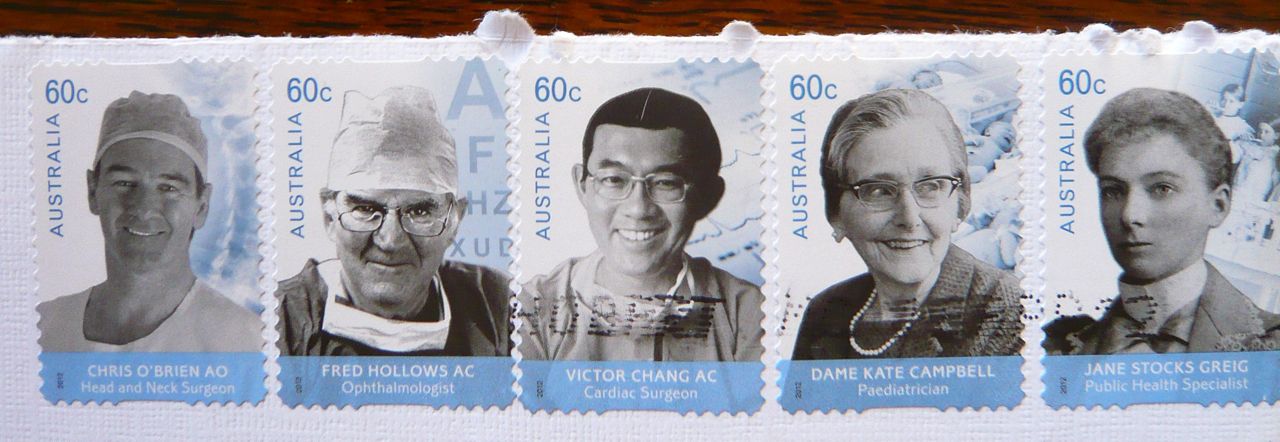
This commemorative stamp coincides with another stamp release in Australia, of well-known Australian doctors, sent to me by my mother.
For those interested in medical philately, there is a specialist in the area called Fred Skvara, who writes articles in the newsletters of the Medical History Society of New Jersey, available online at http://libraries.umdnj.edu/History_of_Medicine/MHSNJ/index.html. Fred's next talk on medical philately will be at the Medical History Society of New Jersey's Spring Meeting, Wed. May 16, Nassau Club, Princeton NJ. For the full program, http://www.mhsnj.org/4.html
Subscribe to:
Posts (Atom)