Saturday, March 21, 2015
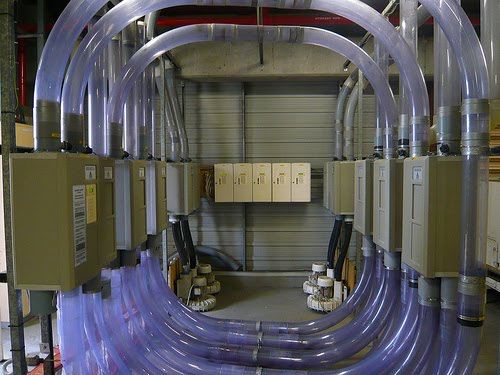
forgotten tubes
"So it was, strolling across the Swanston Street bridge for the first time in forty years, I found myself swimming in the giddiness of time, knowing exactly where I was and having no idea at all. I chose to go to Henry Bucks by way of Flinders Street, in order that I might pass the embalmbed corpse of The Herald building (where I had once been so firmly edited). The bitter wind drove lolly papers past its shuttered doors. I sometimes dream of the Herald as it was so long ago: the marble and terrazzo, oak panels, the whistling thumping vacuum tubes above your head. There are always bizarre copy boys and copy girls with carbon-paper smudges on their cheeks. People come and go in pursuit of unimaginable business. Some walk directly to the banks of clunking lifts. Men in hats rush past the front desk and through a swinging door" (p53)
As I currently stroll Melbourne's Swantston Street and Flinders Street I also find myself "swimming in the giddiness of time", drowning or floating in the unfamiliar known, the uknown familiars of a city I have lived on and off in over the last 10 or so years. On the train into the city, I look out at the old Herald building and imagine all those newspaper copies whirling through tubes many years ago.
Saturday, January 11, 2014
pneumatic dispatches for 2013
Another exciting moment in 2013 was being interviewed by Jacob Aron for an article in New Scientist about pneumatic tube systems. His article was published around the time that pneumatic tubes made general news, when Elon Musk announced his intentions to revolutionize transport with his Hyperloop system. Many reporters compared the Hyperlink to pneumatic tube systems (although it somewhat different, it is in a tube). Fans of pneumatic tube systems were aware of course that this is not such a new idea, with VacTrains and Atmospheric Railways previously capturing the imagination of engineers.
Last year saw a few art installations such as PNEUMAtic circUS, a networked postal art project curated by Vittore Baroni, and the basement oracle in Madison Central Library, as well as DIY projects such as one cool dad's home built pneumatic tube system for tooth fairy transportation. I also attempted the beginnings of a list of pneumatic tubes in fiction, which I updated as the year progressed, sometimes finding mention of the tube in surprising locations (Mr Ian McEwan). More detailed posts were written about Fahrenheit 451, The Atmospheric Railway and The Innocent.
There were also posts throughout the year about pneumatic tubes in newsrooms, dancehalls and cafes. And finally, who could forget the unfortunate Tesco's duty manager who got his arm caught in the supermarket's tube system, not the first it seems, with others also finding their limbs sucked into a pneumatic system.
Image my own from fieldwork in Melbourne, Australia.
Wednesday, October 30, 2013
microscopic crafts
There are also embroideries, felted body parts and other stitched objects which will fascinate anyone with a medical or scientific interest. Considering that Mimi and I bonded in medical school over dissection classes, sewing and imagining microbiology lecture slides as fabric patterns, it is no wonder that our wanderings brought us to this crafty cave. Watch out for an exhibition next year by this clever artist.
Image from Anno Domini Home blog, used with kind permission of Andrew Delaney.
Friday, October 25, 2013
invisible tubes
A few emails later and I am being taken on a tour of the system by Scott, Operations Manager in the Pathology department. Scott takes me into the central pathology lab first, the hub of the system, where specimens are delivered and processed. As we talk a few capsules come flying in from ED. That is one point-to-point track in the system, the other heading to ICU and the private hospital. Someone is there nearby to organise the capsules, empty their contents and send back the tubes to where they came from. This system is all about pathology - no medical records or pharmaceutical items are transported.
The tour continues and we visit the plant room, walk corridors with tubes overhead, and visit the outpatients' department and the haematology department. In the haematology department, blood products, requests, visitors and capsules whizz by. As a trauma hospital, this lab works 24/7, the capsules arriving day and night, needing urgent attention. The outpatients' pathology department is less frenetic but no less busy - as many as 150 - 200 blood samples can be taken here a day.
We walk back to Scott's office and talk over some plans for future pneumatic tube systems in the new pathology department in the hospital, and the challenges of integrating systems from different hospitals, some quite some distance away. The plans are at the concept phase, the system one of possibility at the moment. I leave the pathology department and follow the corridors back to the main entrance. This time the sounds I pay attention to are not the coughs and beeps, but rather the rumble of pneumatic tube capsules overhead.
Photos are my own.
Monday, September 5, 2011
the final days of our medical museums?
Saturday, August 13, 2011
underground explorers

"As Mumford pointed out in early drafts for Technics, in the nineteenth century city planning began to involve not only the disposition of the surface but also an 'underground system of functions [that] form as it were the physiological apparatus of the new city ... the modern city plan involves a co-ordination of the super-surface city with the sub-surface city.' As some more recent historians of technology say, the modern metropolis is a 'networked city'" (p52)
Thursday, January 20, 2011
economical tubes
Fascinating that pneumatic tubes are now catching The Economist's attention. No doubt this technology excites those interested in sustainable and cost-effective transportation of materials. It is a pity however that they had to refer to pneumatic systems as an “extinct technology”, neglecting the many uses of pneumatic tubes in organisations all over the world in the last two centuries.
My own image of pneumatic tubes still in use in a Melbourne hospital, Australia.
Saturday, December 18, 2010
pneu postmarkings
Postal markings for pneumatic mail are of course no exception, and reveal something about the sociohistorical times during which post was sent via tubes. In an essay The Pneumatic Post of Paris by J.D. Hayhurst O.B.E, he writes about the markings in Paris:
"The 'postal' date stamp of 25 mm diameter incorporating a B was applied at the 1889 Exposition Universelle. Again these were usually struck in blue and sometimes in black, but in the first half of 1894 a number of of fives used a violet ink ... At the turn of the century new types of date stamp were introduced which, for the first time, showed the time of despatch of a pneu, so that it was no longer necessary to record this time in the daily register ... A pneu, during its journey from the sender to the addressee, might have to be transferred from one tube line to another and when this occurred the office of exchange applied its date stamp on the back. Using date stamps incorporating times, the times of each stage of a journey could be ascertained. At the big exchanges of Central and Bourse a stamp was mechanically applied. ... In the early days of the pneumatic post, pneus might be addressed, by accident or otherwise, beyond its boundaries; they were then endorsed in manuscript 'Hors limites' or 'Hors service' and transferred to the post. The sorters tired of writing and made up their own handstamps for these and other annotations. In this category of individual initiative handstamps is 'BOURSE B' (B for banlieue) applied to pneus arriving at Bourse for the suburbs after the last despatch and held there overnight"
Stamps such as these above are markers of the journey of 'the pneu', a tangible trace of the history of the post which says 'I have passed through this place on this date'. I love that the life of the post is recorded, however partially, and also the ways in which mail staff adapted the stamps to suit their own purposes, such as the handstamp to redirect wrongly addressed mail. I can't help but wonder what traces are left on contemporary 'packages' sent via pneumatic tube systems?
See my mother's blog for a post on a similar theme. Hand cancellation stamp images from Wikipedia and the beautiful first day cover from Motor Filatelisten Nederlands.
Monday, October 18, 2010
duct tape: it’s useful for things you haven’t even thought of yet
Duct tape is a remarkable thing. According to Wikipedia, duct tape has saved the lives of NASA astronauts, can help with iphone glitches and even treat warts (the controversial treatment is otherwise known as duct tape occlusion therapy). Of course MacGyver always had some in his back pocket and The Duct Tape Guys know of a million more wackier uses. But the reason I am writing about duct tape on this blog, is that during a recent visit to a hospital pneumatic tube system (much more about this great trip in later posts), I found many of traces of the stuff:
Wednesday, September 29, 2010
artists in residence

There are arts-based projects in hospital contexts such as Hearing Voices, Seeing Things, the two-year program of residencies with staff and users at North East London Mental Health Trust led by artists Bob and Roberta Smith and Jessica Voorsanger, and Transplant, a collaborative piece of work from Tim Wainwright and John Wynne. Both of these projects explore themes central to many sociological studies of health and illness. Katerina Cizek's filmaker-in-residence project at St Michael's Hospital in Toronto was also incredibly sociological.
Artists such as Barbara Hepworth, Christina Lammers, Bill Viola, Heather Spears and Christine Borland have had residencies in hospitals, akin to hospital ethnographies. Barbara Hepworth produced a wonderful series of fenestration drawings of her time in ENT theatres, whilst Bill Viola's installation Science of the Heart is from his time at Memorial Medical Centre in Long Beach, New York. Heather Spears spends her residencies in neonatal intensive care units whilst Christine Borland spent a week at the University of Alberta Hospital, producing a piece of work presented in the exhibition, Imagining Science, at the Art Gallery of Alberta. Borland worked with two patients having kidney biopsies, taking photographs at the start of the procedure, then accompanied the tissue through its journey through the many processes of the Pathology Laboratory. It is a work which I think has a lot of relevance to the role of pneumatic tube systems in hospitals for the artwork brought the patient into the laboratory and the experience of the laboratory to the patient:
“Throughout the week (of her residency) the artist tread a path between the lab and the wards, building an intense, personal relationship with the patients and staff at each end. For the patients the ‘end product’ was a 10 minute long, self-running PowerPoint presentation of the hundreds of images documenting their journey through the hospital and laboratory system. As the patients watched this for the first time, entirely absorbed while it was presented to them on the artist’s lap-top, they were filmed from a tiny camera embedded in the frame of the laptop screen which captured their reactions and expressions in the most non-mediated way possible”
Artists are also taking up residencies in genetic research institutes and natural history museums, and their work is being shown in hospitals and other medical sites.
Artistic representations explore research topics in more ambiguous and incomplete ways than academia often allows, this work evoking different stories on common subjects. There are many parallels between artist-in-residencies and ethnographic fieldwork which are interesting to think about. No doubt ethnographers can learn from artists and vice versa. Collaborative work between sociologists and artists raises a number of theoretical and methodological issues which are challenging and potentially rewarding to investigate. There is a lot of exciting work happening in this area, and pneumatic tubes is only one topic, amongst many, that could be explored.
The photo was taken by Thomas, as part of a photographic study of overseas doctors' practices in Australian hospitals, in collaboration with my ethnographic work at this site.
Wednesday, August 18, 2010
building as both a noun and a verb

The deadline for submissions is November 30th 2010 and more information can be found here."Are buildings fixed objects? At what point is a work of architecture complete? Architects tend to consider a building as finished, fixed, upon the completion of building works. The unpopulated images of shiny new buildings in the architectural press are presented as a record of the building as a ‘pure’ art-object at its temporal zenith; the occupation of the building and its subsequent adaptation, alteration, personalization and appropriation by people is often perceived in terms of decline. ‘Fixed?’ aims to question this view of architecture.
An alternative perspective is that all buildings are incomplete and subject to change over time as the users constantly alter and adapt their surroundings in response to changing cultural and technological conditions. Architecture is appropriated both intentionally and instinctively. In this way, often beyond the control of the architect, through their lifecycle all architectures become responsive to people and place. In theoretical terms, a work of architecture can therefore be interpreted not only as an ambiguous physical form but also as a shifting, responsive cultural construct.
Proposals for both theoretical discussion and case-study based papers are invited that engage with or challenge the theme of incompleteness and change across architecture, design and the built environment. Possible strands include: - changing, transient and adaptive everyday architectures and modern vernaculars - the afterlife, use, occupation, adaptation and appropriation of ‘fixed’ designed buildings, spaces and places - architects responses to the challenge of incompleteness and life-cycle design"
The conference raises interesting questions about technologies in buildings such as hospitals which are usually outdated by the time they are built. Hospitals are often considered 'fixed' buildings, adhering to the 'order' of biomedicine, yet I found in my PhD research that hospitals are much more open to the creative practices of its inhabitants. My recent tour of a pneumatic tube system in a Melbourne hospital certainly reiterated that this is also the case with pneumatic systems.
The idea of incomplete buildings is aligned with mat-building philosophy, a great example of which was Le Corbusier's (never built) Venice Hospital Project, represented in these collages in the MoMA collection. The conference will no doubt raise interesting points about how users adapt to architectural infrastructures, and how architecture adjusts to its users.
Sketch of one of the hospitals where I did fieldwork for my PhD, by my father, John Harris.
Monday, July 26, 2010
the pneumatic underground
Unfortunately, for a number of reasons, I did not have a chance to see the workings of Melbourne's electrical supply this year. However, the intense public interest in this site made me realise how fascinated people are by the 'inner workings' of our urban spaces. This led me to wonder about pneumatic tours in a city, in banks, supermarkets and of course hospitals. I know that during Atlas Obsura's Obsura Day, on March 20th this year, there was a tour of Stanford Hospital's pneumatic tube system by chief engineer Leander Robinson. What a great idea! It is a potentially fantastic way to bring together those interested in this topic together in person (who often chat online), as well as potentially drawing in a wider public to explore the magic of pneumatic tubes.
Post title from Banvard's Folly by Paul Collins.
Tuesday, June 29, 2010
my medical museum
Gradually, over the years, the Medical History Museum at the University of Melbourne has become more than a distraction, and since March this year I have been volunteering there every Thursday afternoon. I share a computer and little office with Ann (another staff member), an operating table, anaesthetic equipment and hundreds of locked and labelled wooden boxes. It is dusty and cluttered and I love it!
The museum was established in the library in 1967, with a grant from the Wellcome Trust. A beautiful 19th century Savory and Moore pharmacy, shipped from Belgravia, London, is installed in the museum, complete with bottles and gold-labelled herb drawers. On display there are also microscopes, amputation sets and bleeding equipment, in walnut display cases. Currently there is a temporary exhibition about apothecaries -The Physick Gardener: Aspects of an Apothecary's World - curated by the museum’s new curator Susie Shears. Behind a hidden door in the pharmacy are the curator’s offices and storage areas, where chests and drawers may contain pathological slides or stapleguns, and shelves are filled with boxes, books and ephemera.
There are many treasured items in the museum’s collection including specie jars, pill rolling machines and medicine chests used by doctors during visits to rural areas in Australia. One of the oldest photographs (1864), and one of my favourites, depicts the first medical students carrying out work in the Anatomy Dissecting Room, under the supervision of Professor Halford, and the watchful gaze of the medical school porter.
Professor George Britton Halford (1824 – 1910) was a lecturer in London, before taking the first chair of anatomy, physiology and pathology at the University of Melbourne. He moved to the antipodes with anatomical and pathological specimens he had collected for a museum, and books to start a library. His first practical classes and lectures were held in the converted coach-house of his private residence, before moving to the newly completed medical school in 1864.
Professor Halford played an important role in the teaching and administration of the new medical school in Melbourne, and was a strong advocate for female students. He arrived in Melbourne with an established record as a researcher (one of his most important essays being The Action and Sounds of the Heart: A Physiological Essay (1860)) but his later controversial experiments with snake venom damaged this reputation.
The objects and documents I found associated with Halford provide a window not only into the life of a contentious researcher and teacher, but also into the collection of the Medical History Museum. Amongst Halford’s material objects and paper artefacts, there is: a Powell and Lealand compound monocular and binocular microscope stored in a walnut case with a handwritten inventory; a cabinet of microscope slides commercially and handmade between 1860 and 1889; a paper entitled ‘On a Remarkable Symmetrically Deformed Skeleton’ (1868); photographs of the professor and his family; and his business card.
Other pieces in the collection associated with Halford include a student’s set of lecture notes compiled during Professor Halford’s anatomy and physiology lectures throughout 1877. This leather bound exercise book, with John Springthorpe’s scribblings and coloured pencil illustrations, is the only surviving example of Professor Halford’s teaching.
All of these objects are material remnants of Professor Halford’s time at the University of Melbourne. They are microscopic slices of a time when medical students wore aprons and dissected on wooden tables and when slides were handmade. The objects are portals into the past that overlap with my curiosity of the future. They are just some of the thousands of wonderful stories to be found in my medical museum.
Friday, June 18, 2010
a brief tour of a hospital's network
Waiting for the elevators, I found out that the tube system dealt with 2,400 'transits' a week, servicing over 30 units within the hospital. All computer controlled - Frank could even manage the system from his home computer. It was fast, he said. Fast communication; "a highway hidden from the cosmetic face of the hospital". The system meant that the doctors and nurses didn't have to run around with samples. The workload is increasing he told me. Increasing because of the number of tests they are doing, and because diseases are becoming more complicated.
Soon we were heading down the corridor to the pathology department where we were admitted into a humming hive of pathological activity. Majestically, at the end of the room, stood one of the largest pneumatic tube processing units in the building; the endpoint of three separate railways throughout the hospital. Frank showed me how the pathologists used to put too many canisters in the system, and how his technicians had adjusted the infrastructure so that the pathologists could only fit one canister. There were towels lying in the troughs, hospital towels, ready to catch the falling tubes. I loved these signs of adaptation of the system.
On our way out of the pathology department Frank told me that the whole system depended on its users. When things went wrong he knew who to blame - the doctors. "The illogical things that humans do ... humans don't realise the logic of machines". He told me that the doctors would put samples in the canisters incorrectly, leading to spillage. His team would have to clean the canisters carefully, with antiseptic. Even worse however, the fluids would leak into the vacuum, causing trouble. Frank very carefully explained to me the difference between pneumatic and vacuum, which I still don't understand. I was puzzling over these simple engineering facts as we walked back along the corridor. He pointed out the window to the top of the other side of the hospital building, to the plant room, where the pumps for the system were housed.
It was time then for our tour to finish. Frank had to get back to work. His pager had remained silent but there was always something to do. He was a tradesman, he said. A tradesman who loved hospitals. He had worked in the hospital for the last 21 years. Almost everyone we passed in the corridors had said hello. I could tell there was much more to learn from Frank. He gave me his business card (after rifling through his stack, most with little notes to himself on the back), and I will call him again one day.
Monday, June 14, 2010
pneumatic wanderings
Image via the Ephemera Society.