Wednesday, November 23, 2016
never getting off the (under)ground
The article looks great and I have downloaded it to read - if you can't access a copy but would like to read it too, let me know by email and I will forward a PDF through my library.
Image of Beach's system by Scientific American - Scientific American - March 5, 1870 issue, Public Domain, https://commons.wikimedia.org/w/index.php?curid=27708042
Wednesday, March 25, 2015
pneumatic news
Thursday, August 15, 2013
elon musk's non-pneumatic tube
And if you have read any of the media coverage, you've probably read something about pneumatic tubes too.
It seems that journalists can't help but compare the Hyperloop to pneumatic tubes, despite the engineering principles being quite different, and Musk's insistence that it works very differently to pneumatic tube systems. The Telegraph describes the Hyperloop as a modern day pneuamatic travel system, while The L.A. Times calls is the "equivalent of a 450-mile pneumatic tube". WIRED write that the engineering is similar to "old-school" pneumatic tube systems, and the Globe and Mail said the Hyperloop system was "not unlike the pneumatic tubes that transport capsules stuffed with paperwork in older buildings. In this case, the cargo would be several people, reclining for the ride".
Why do the comparisons persist? Well besides the obvious tube-like appearance of the transportation system, I think that these comparisons tie into a romantic notion of transporting people around the world like parcels and letters, by pneumatics. As I wrote previously, it is a science-fiction fantasy imagined by many entrepreneurs in the past, so a comparison to pneumatic tubes links Elon Musk to this lineage of great imagination.
His ideas certainly seem to have sparked the imaginations of many tech-bloggers and micro-bloggers who are already lining up for the first $20 ticket. For others though it has led to daydreams of times gone by, such as Paul Whitefield from the LA Times:
"I remember when we had pneumatic tubes here at The Times. We used them to whoosh cylinders full of important documents from the newsroom on the third floor to the composing room on the second floor. Quite often, they got stuck. People got paid to fish the cylinders out. One time, a fellow newsman tried to do the job himself. He got his arm stuck in the tube. So the people who got paid to fish the cylinders out had to fish him out too. It's just one more great thing about journalism that the Internet has killed".Image from Twitter.
Friday, July 26, 2013
pneumatic tube transportation, or the love of technology
This kind of idea isn't new of course. VacTrains have captured the imagination of engineers and science-fiction writers for over a century. In real life there has been the Atmospheric Railway which I blogged about recently and perhaps most famously Alfred Beach's NYC system, both of which failed to fully eventuate.
So why does the idea linger? What brings entrepreneurs to tube transportation decade after decade? Do we now have the technologies to support this idea, or are we destined for another Beach system, another ARAMIS? Either way, it is always about a love of technology ...
Read about Beach's pneumatic tube transportation dream here (NYC subway essay) and here (Joseph Brennan's wonderful online book).
Image from DavidsZondy.com, transportation of the future.
Tuesday, July 16, 2013
atmospheric stories
The Atmospheric Railway
The short story starts with Neville on a train. It is a Sunday night in January. Neville is a grandfather in a soft red jumper. He is remembering the weekend, and his adventures into researching the Atmospheric Railway. The adventures are started by the stories of his aunt, Florence. Neville and his sister Beryl only have faint memories of Florence. But they have found out, through her diaries, that there was a potential romance between her and Archie Erskine, who worked on the Atmospheric Railway. Here the train carriages connect, and we are told about Neville's fascination with Archie, and the Railway he worked on.
The reader learns about the various atmospheric or pneumatic railways of England, including Brunel's South Devon Railway, "which cynics referred to as his 'Atmospheric Caper'" (p14)"
"There were frequent break-downs, when third-class passengers had to disembark and push, but the chief problem again was the leather sealing valve, which deteriorated, and was eaten by rats. Constant replacement would have proved too costly. Neville realised that he was just a dilettante and that there existed a cyber community of troglodytes who were experts in the lost tunnels and rivers of England, subterranean trolls and elves inhabiting the ghostly pumping stations and engine houses of south London" (p14).There is a reference to an excursion that Florence took on the Atmospheric Railway with her students:
"It cost sixpence a ride and she must have paid from her own pocket, Beryl said. Neville had not read it het but was looking forward to Beryl's photocopied version. The railway, propelled by a steam engine coupled to a fan 22 feet in diameter, ran through a tunnel 600 yards in length and 10 feet in diameter. The tunnel gradient was 1 in 15 inches, with a sharp curve ... There were thirty-five seats in the Atmospheric Railway's coach ... All the passengers must have shared the excitement, united in the democracy of novelty as they travelled into the scientific future" (p18).Not everyone was travelling into the future though. In the story we read of male passengers who were left behind on the platform after they had got out to push flailing railcars. The story ends when the guard of Neville's train is also nearly left behind.
Image from Wikipedia.
Saturday, July 13, 2013
pneumatic tube factory tour part one: atmospheric beginnings
The first connection was made in a Thai restaurant in Exeter. The connection was between me, pneumatic tube enthusiast, and Christine, philosopher, sociologist and member of the Hörtig pneumatic tube family. While leaning over to dip my spring roll in sweet chilli sauce during a work dinner, I overheard my colleague Christine tell her neighbour about her family's business making and installing pneumatic tube systems. I almost dropped the spring roll. Many conversations ensued, and the seeds were planted for a factory visit ...
Exeter seems a perfect place for this story to begin, for it is the site of Brunel's pneumatic, or atmospheric railway. Inspired by Irish atmospheric railways, Brunel built a section of atmospheric rail between Exeter and Newton (Abbot) which lasted almost a year, from 1847 to 1848. Imagine buying one of the three shilling one dime tickets to board such a train!
Luckily there seem to have been windows, for this is one of the most beautiful sections of British rail, running along the coast between Starcross and Teignmouth. I travelled almost every day along this train line with my husband last year, as we commuted between Totnes and Exeter. Some days the sea would be roaring against the train windows, other days it was calm. It always changed colour. The water certainly caused havoc for maintaining seals in the vacuum in the atmospheric railway with the leather flaps eroded by salt.
The pneumatic train line is now long gone, although you can see sections of the track in Didcot Pathway, or visit the Atmospheric Railway Pub in Starcross. Or you can just take the magnificent, atmospheric, journey between Exeter and Totnes, and imagine the railway as it was, for yourself.
Image of a section of the South Devon atmospheric railway from Wikipedia, and image of Teignmouth sea wall from Barry Lewis' Flikr photostream.
Tuesday, August 2, 2011
experiments in bacterial communication

"A large-scale collaborative crochet based on the bacteria from the artist’s own bed, an indigo blue coloured patchwork stained with MRSA bacteria grown on chromogenic agar and patterned with clinical antibiotics and other tools in the research and treatment of this disease, [and] a Whitework embroidered lab coat patterned with images of bacteria and moulds found on it"


Thursday, March 3, 2011
the tubes of tomorrow: the future marches on!
One essay, by Dutch researcher Harro van Lente, examines the different kinds of language involved in voicing the technological future. He writes that often historical instances are used to formulate technical progress as one piece of ongoing evolution, that is inevitable, and must not be stopped.
This essay is very relevant to the work I am doing on genetic research which steams ahead at a remarkable, seemingly unstoppable pace. But I am also interested in how pneumatic tubes are used as a linguistic device to represent the future of technological progress.
This wonderful prune commercial filled with pneumatic-people tubes, wrinke technicians and rockets seems to be a great example of van Lente's argument, that images of history are pulled together to create a narrative of technological achievement.
Thanks to James Veitch @seamusamadan for his link to this video on twitter.
Tuesday, February 8, 2011
Pneumatics at the Palais
"Serge Spitzer aims to reveal hidden elements, structures and systems, the effects of which we perceive without trying to question their nature. Since the 1970s, he has been formulating mechanisms of communication, perception, and consciousness. These “reality models” are extraordinarily lucid sculptures in which everyday life confronts while merging with the imaginary. The artist borrows a complex vocabulary from our surroundings to generate the constant conflict and equilibrium of his works ... Re/Search, Bread and Butter with the ever present Question of How to define the difference between a Baguette and a Croissant, a monumental installation first made in 1997 for the Lyon Biennial, coincides with the democratization of the Internet. Presented today in the context of information technology hegemony, this work attests to the pre-existence of a quasi-organic communication network. Serge Spitzer unveils a chaotic pneumatic transport system where capsules, propelled by air, whizz through a maze of tubes. Installed in 1866 under the streets of Paris, this kind of device originally served to transmit commercial orders between the Central Telegraph Office and trading rooms. By bringing a technology back into the public space that ordinarily lurks under our towns, like a beast in a cave, Serge Spitzer ironically interrogates its function and renders it perfectly obsolete. The installation brings together two systems that work against each other, but are forced to coexist together; the networks neutralize each other. Messages shoot through these vessels without sender, without recipient, and on a quest without beginning or end. Here, order faces off with chaos and stringency brushes against weakness: everything is intertwined, but all of it is accidental"
"The chaos of this seemingly stable structure, and the free will of controlled units is at the core of this piece: "The idea is to create the sketch of a chaotic structure that you follow and discover the 'clear' reality around it. The message of the work is to create something which is a question to itself. You build structures which seem to be very clear in their functions. But as you realise the work, you discover the irrationalities in the system. The narrative is about reality. You think the piece is about itself but it’s actually about the world around it, about the people, architecture, about the structure, you also look differently at the colours outside, or details and their relative monumentality. A big wild crazy transparent structure seen trough a large glass wall and next door you see the Eiffel tower, the most rational functional construction.”It is the so-called 'irrationalities' of pneumatic tube systems which fascinate me too. The free will and the structure, always in tension, visible in the adjustments that engineers make to networks, in the sketches architects draw during renovations, in the breakdowns and in the repair work that takes place in hospitals, banks, pharmacies and other places everyday.
Thursday, January 20, 2011
economical tubes
Fascinating that pneumatic tubes are now catching The Economist's attention. No doubt this technology excites those interested in sustainable and cost-effective transportation of materials. It is a pity however that they had to refer to pneumatic systems as an “extinct technology”, neglecting the many uses of pneumatic tubes in organisations all over the world in the last two centuries.
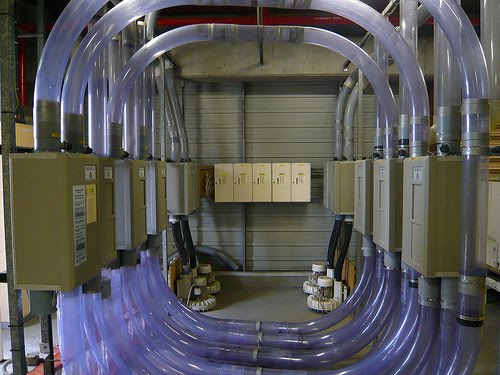
My own image of pneumatic tubes still in use in a Melbourne hospital, Australia.
Tuesday, January 11, 2011
retro-futures
The retro-futuristic representation of pneumatic tube systems is certainly often cast in a utopian light, although the bureaucratic monotony of the technology also has a dystopian air in works such as 1984 and Brazil. For those who are optomistic, Nowotny writes that “the space of the future is filled with new technological visions and highly promising mini-utopias that hold the potential to make life easier, better, and more beautiful”. This seems a wonderful description of how pneumatic tubes are often considered in hospitals, banks and homes. Pneumatic tubes have made their way into a number of futuristic scenarios, most noteably Futurama's Tube Transport System (for Futurama's best healthcare moments, see this Comedy Central post) and the Jetsons, as well as 1984 and Brazil. Whilst pneumatic tubes are often projected as something of the future, they are not new. The new is unknown, whereas the future, or our vision of it, often says much more about the present and the past.
Retro-futuristic images of pneumatic tubes have many traces of another era of technological advance - the industrial revolution. We can learn about this history, and much more, by looking at how, as society, we consider, represent, use and play with 'technologies of the future'.
Image from Vintage Culture.
Wednesday, October 6, 2010
pneumatic transportation: the stuff of dreams

Speeding into the future, the world of Futurama is connected via a vast pneumatic tube network. Whilst Beach’s subway was never realised in its original form, and Futurama’s system is the stuff of science fiction, there are nonetheless a number of ways in which humans can be catapulted through the atmosphere via pneumatics. There are the nifty elevators for one, and now something which has recently captured my attention, the shweeb. OK, so the shweeb doesn’t really count as pneumatic transport (and is much more about pedal power), but it certainly resembles a pneumatic capsule. Google has recently backed the invention, with many asking: why? Should such inventions remain the stuff of dreams and TV shows?
Beach pneumatic plan from Wikimedia Commons.