
Wednesday, July 24, 2013
officially secured
Several years ago I posted about a postmasters' apology, documented in a ready-made sticker designed for when any errors in pneumatic tube transport occured. Such stickers are still in circulation for when mail is damaged, as evidence from the this delightful piece of mail which arrived for me from Exeter the other day ...
 Image my own.

Saturday, July 20, 2013
pneumatic circus
I have covered various artistic interpretations of pneumatic tubing systems before on this blog, as well as museum displays for children, but I have just been told about one of the most imaginative, interactive and creative pneumatic tube artistic installations yet: PNEUMAtic circUS.

PNEUMAtic circUS was a networked postal art project curated by Vittore Baroni, music critic, "explorer of countercultures", and avid activist for mail art, in collaboration with Tatiana Bazzichelli (sociologist of communication with interest in hactivism), Jonas Frankki (designer responsible for Berlin collective Telekommunisten) and Mauro Guazzotti (leader of experimental noise/industrial band). It was held as part of the transmediale festival for art and digital culture, from January to February 2013 in the Haus der Kulturen der Welt in Berlin.
The project involved one hundred mail artists sending in pneumatic post capsules with instructions and scores to be used by the festival visitors for actions and performances.
 Artists came from sixteen countries. That is twice as many countries as arms of an octopus, the mascot for the project, also fabulously called P7C-1 Intertubular Octosocial Pneumatical Postal Network, with its tentacles of tubing spreading across the installation space.


See also the Telekommunisten.net website for more about the exhibition and a terrific "inside the OCTO" video.
Images used with permission from the PNEUMAtic circUS Flikr page.

PNEUMAtic circUS was a networked postal art project curated by Vittore Baroni, music critic, "explorer of countercultures", and avid activist for mail art, in collaboration with Tatiana Bazzichelli (sociologist of communication with interest in hactivism), Jonas Frankki (designer responsible for Berlin collective Telekommunisten) and Mauro Guazzotti (leader of experimental noise/industrial band). It was held as part of the transmediale festival for art and digital culture, from January to February 2013 in the Haus der Kulturen der Welt in Berlin.
The project involved one hundred mail artists sending in pneumatic post capsules with instructions and scores to be used by the festival visitors for actions and performances.


You can find the gorgeous catalogue from the installation here (front cover below), with essays from the curators and many images too. The digital catalogue was unveiled recently in Viareggio, the launch marked by further pneumatic performances, with a workshop where attendees could create and transmit their own messages.


See also the Telekommunisten.net website for more about the exhibition and a terrific "inside the OCTO" video.
Images used with permission from the PNEUMAtic circUS Flikr page.
Tuesday, July 16, 2013
atmospheric stories
The Atmospheric Railway: New and Selected Stories, by Shena MacKay (2010, Vintage Books, London).
The Atmospheric Railway
The short story starts with Neville on a train. It is a Sunday night in January. Neville is a grandfather in a soft red jumper. He is remembering the weekend, and his adventures into researching the Atmospheric Railway. The adventures are started by the stories of his aunt, Florence. Neville and his sister Beryl only have faint memories of Florence. But they have found out, through her diaries, that there was a potential romance between her and Archie Erskine, who worked on the Atmospheric Railway. Here the train carriages connect, and we are told about Neville's fascination with Archie, and the Railway he worked on.
The reader learns about the various atmospheric or pneumatic railways of England, including Brunel's South Devon Railway, "which cynics referred to as his 'Atmospheric Caper'" (p14)"
Image from Wikipedia.

The Atmospheric Railway
The short story starts with Neville on a train. It is a Sunday night in January. Neville is a grandfather in a soft red jumper. He is remembering the weekend, and his adventures into researching the Atmospheric Railway. The adventures are started by the stories of his aunt, Florence. Neville and his sister Beryl only have faint memories of Florence. But they have found out, through her diaries, that there was a potential romance between her and Archie Erskine, who worked on the Atmospheric Railway. Here the train carriages connect, and we are told about Neville's fascination with Archie, and the Railway he worked on.
The reader learns about the various atmospheric or pneumatic railways of England, including Brunel's South Devon Railway, "which cynics referred to as his 'Atmospheric Caper'" (p14)"
"There were frequent break-downs, when third-class passengers had to disembark and push, but the chief problem again was the leather sealing valve, which deteriorated, and was eaten by rats. Constant replacement would have proved too costly. Neville realised that he was just a dilettante and that there existed a cyber community of troglodytes who were experts in the lost tunnels and rivers of England, subterranean trolls and elves inhabiting the ghostly pumping stations and engine houses of south London" (p14).There is a reference to an excursion that Florence took on the Atmospheric Railway with her students:
"It cost sixpence a ride and she must have paid from her own pocket, Beryl said. Neville had not read it het but was looking forward to Beryl's photocopied version. The railway, propelled by a steam engine coupled to a fan 22 feet in diameter, ran through a tunnel 600 yards in length and 10 feet in diameter. The tunnel gradient was 1 in 15 inches, with a sharp curve ... There were thirty-five seats in the Atmospheric Railway's coach ... All the passengers must have shared the excitement, united in the democracy of novelty as they travelled into the scientific future" (p18).Not everyone was travelling into the future though. In the story we read of male passengers who were left behind on the platform after they had got out to push flailing railcars. The story ends when the guard of Neville's train is also nearly left behind.
Image from Wikipedia.
Saturday, July 13, 2013
pneumatic tube factory tour part one: atmospheric beginnings
On the 13th June 2013 I was lucky enough to spend a whole day touring the Hörtig pneumatic tube factory in Bayreuth, Germany. I couldn't think of a better way to spend my holidays. I was like Charlie amongst the chocolate, eyes wide, glass elevators of plastic tubing all around me. This is how I got my golden ticket for the factory tour:
The first connection was made in a Thai restaurant in Exeter. The connection was between me, pneumatic tube enthusiast, and Christine, philosopher, sociologist and member of the Hörtig pneumatic tube family. While leaning over to dip my spring roll in sweet chilli sauce during a work dinner, I overheard my colleague Christine tell her neighbour about her family's business making and installing pneumatic tube systems. I almost dropped the spring roll. Many conversations ensued, and the seeds were planted for a factory visit ...
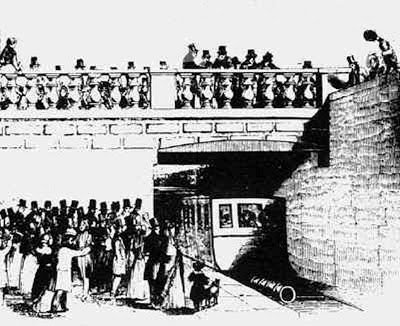
Exeter seems a perfect place for this story to begin, for it is the site of Brunel's pneumatic, or atmospheric railway. Inspired by Irish atmospheric railways, Brunel built a section of atmospheric rail between Exeter and Newton (Abbot) which lasted almost a year, from 1847 to 1848. Imagine buying one of the three shilling one dime tickets to board such a train!
Luckily there seem to have been windows, for this is one of the most beautiful sections of British rail, running along the coast between Starcross and Teignmouth. I travelled almost every day along this train line with my husband last year, as we commuted between Totnes and Exeter. Some days the sea would be roaring against the train windows, other days it was calm. It always changed colour. The water certainly caused havoc for maintaining seals in the vacuum in the atmospheric railway with the leather flaps eroded by salt.
The pneumatic train line is now long gone, although you can see sections of the track in Didcot Pathway, or visit the Atmospheric Railway Pub in Starcross. Or you can just take the magnificent, atmospheric, journey between Exeter and Totnes, and imagine the railway as it was, for yourself.


Image of a section of the South Devon atmospheric railway from Wikipedia, and image of Teignmouth sea wall from Barry Lewis' Flikr photostream.
The first connection was made in a Thai restaurant in Exeter. The connection was between me, pneumatic tube enthusiast, and Christine, philosopher, sociologist and member of the Hörtig pneumatic tube family. While leaning over to dip my spring roll in sweet chilli sauce during a work dinner, I overheard my colleague Christine tell her neighbour about her family's business making and installing pneumatic tube systems. I almost dropped the spring roll. Many conversations ensued, and the seeds were planted for a factory visit ...
Exeter seems a perfect place for this story to begin, for it is the site of Brunel's pneumatic, or atmospheric railway. Inspired by Irish atmospheric railways, Brunel built a section of atmospheric rail between Exeter and Newton (Abbot) which lasted almost a year, from 1847 to 1848. Imagine buying one of the three shilling one dime tickets to board such a train!
Luckily there seem to have been windows, for this is one of the most beautiful sections of British rail, running along the coast between Starcross and Teignmouth. I travelled almost every day along this train line with my husband last year, as we commuted between Totnes and Exeter. Some days the sea would be roaring against the train windows, other days it was calm. It always changed colour. The water certainly caused havoc for maintaining seals in the vacuum in the atmospheric railway with the leather flaps eroded by salt.
The pneumatic train line is now long gone, although you can see sections of the track in Didcot Pathway, or visit the Atmospheric Railway Pub in Starcross. Or you can just take the magnificent, atmospheric, journey between Exeter and Totnes, and imagine the railway as it was, for yourself.


Image of a section of the South Devon atmospheric railway from Wikipedia, and image of Teignmouth sea wall from Barry Lewis' Flikr photostream.
Thursday, July 11, 2013
tube cam
While it has been a few months since I have blogged about pneumatics, they certainly haven't strayed too far from my thoughts - how could they! I've enjoyed novels and short stories about them, heard about fantastic pneumatic art projects, spent a day in a pneumatic tube factory and kept up-to-date with all of the latest hospital installations. Which means many interesting pneumatic posts to come, so stay tuned!
In the meantime, a video to share, posted by Exploratorium, called Science in the City: Pneumatic Tubes. It is a little documentary about the famous Stanford Hospital system which has inspired many creative adventures by pneumatic tube lovers. This one is special for its camera footage, dubbed by a commenter as "tube cam". The visuals and sounds are wonderful in this footage, which feels like a mix between a waterslide ride and an endoscopic exploration.

Still video image of inside a hospital pneumatic tube from YouTube, Science in the City: Pneumatic Tubes.
In the meantime, a video to share, posted by Exploratorium, called Science in the City: Pneumatic Tubes. It is a little documentary about the famous Stanford Hospital system which has inspired many creative adventures by pneumatic tube lovers. This one is special for its camera footage, dubbed by a commenter as "tube cam". The visuals and sounds are wonderful in this footage, which feels like a mix between a waterslide ride and an endoscopic exploration.

Still video image of inside a hospital pneumatic tube from YouTube, Science in the City: Pneumatic Tubes.
Saturday, April 20, 2013
caught in the tube but no 'arm done
I noticed the other day, for the first time (although I am sure that someone has told me before), that my local supermarket has Lamson pneumatic tube systems at the cash registers. It may just be the extreme weariness that overcomes me at the Albert Heijn but it shows you have to keep your eyes out for this technology!
Eyes out, but arms in! A poor Tesco's duty manager made news in Manchester recently because of an unfortunate incident at his pneumatic cash system. The young man's arm got caught in the tube system, suspended vertically for 30 minutes. The reasons the limb found it into the vacuum are unclear - perhaps doing some "maintenance work" on the tube? Fire crews came to the rescue and dismantled the tube, using a (pneumatic) saw to release the man from the contraption. Unfortunately for the red-faced duty manager, as it was a 24 hour supermarket the store didn't close during the fireman's efforts so there were plenty of spectators to enjoy the event.
Eyes out, but arms in! A poor Tesco's duty manager made news in Manchester recently because of an unfortunate incident at his pneumatic cash system. The young man's arm got caught in the tube system, suspended vertically for 30 minutes. The reasons the limb found it into the vacuum are unclear - perhaps doing some "maintenance work" on the tube? Fire crews came to the rescue and dismantled the tube, using a (pneumatic) saw to release the man from the contraption. Unfortunately for the red-faced duty manager, as it was a 24 hour supermarket the store didn't close during the fireman's efforts so there were plenty of spectators to enjoy the event.
Sunday, April 14, 2013
jetsons again
Described as the most Jetsonian of technological wonders, pneumatic tubes were the topic of the Smithsonian blog recently. Matt Novak described how pneumatic tubes appeared in a particular episode amongst a dazzling array of other futuristic technologies such as videophones, 3D TV, cleaning robots and moving sidewalks. All of these technologies he suggests, are "masquerading as scenery while they're in fact the star of the show".

This episode is titled Miss Solar System, and was aired on February 10th, 1963. It featured a horizontal pneumatic tube system with multiple points of entry and exit, which differed from the vertical systems used in previous episodes.
Image from the Smithsonian blog.

This episode is titled Miss Solar System, and was aired on February 10th, 1963. It featured a horizontal pneumatic tube system with multiple points of entry and exit, which differed from the vertical systems used in previous episodes.
Image from the Smithsonian blog.
Wednesday, April 10, 2013
in the newsroom
Julie Starr posted this wonderful photo from the New Zealand Herald Manual of Journalism, 1967, on her blog The Evolving Newsroom. It appears that accepting copy from the editorial department and sending galley proofs via pneumatic tubes was once a busy job for printers - I can see at least seven shutes!


Friday, April 5, 2013
basement oracle
Late last year an empty library was transformed into a free art/music event for Madison residents. The one day festival Bookless (see more details on the Library as Incubator Project site), celebrated many loved features of the old Madison Central Library including card catalogues and pneumatic tubes. The pneumatic tubes, pictured here in their former life, were turned into a basement oracle, delivering fortunes to Bookless visitors.

As messages are delivered from pneumatic pipes, they often appear to come from nowhere - an oldfashioned mystery - capturing the imagination of the public. My sister Chelsea will be writing a guest post for pneumaticpost on other ways in which pneumatic tubes have been used in museums, as ways of fascinating and engaging visitors.
Image of the pneumatic tubes in the old Madison Central Library from Madison Guy's Flikr photostream. See Madison Public Library's Flikr photostream for an image from the Bookless exhibition.

As messages are delivered from pneumatic pipes, they often appear to come from nowhere - an oldfashioned mystery - capturing the imagination of the public. My sister Chelsea will be writing a guest post for pneumaticpost on other ways in which pneumatic tubes have been used in museums, as ways of fascinating and engaging visitors.
Image of the pneumatic tubes in the old Madison Central Library from Madison Guy's Flikr photostream. See Madison Public Library's Flikr photostream for an image from the Bookless exhibition.
Tuesday, April 2, 2013
waiting and watching some tubes
Waiting for a baby to come - image by Andy from a radiology waiting room, Panti Rapih Hospital, Indonesia.


Subscribe to:
Posts (Atom)


